
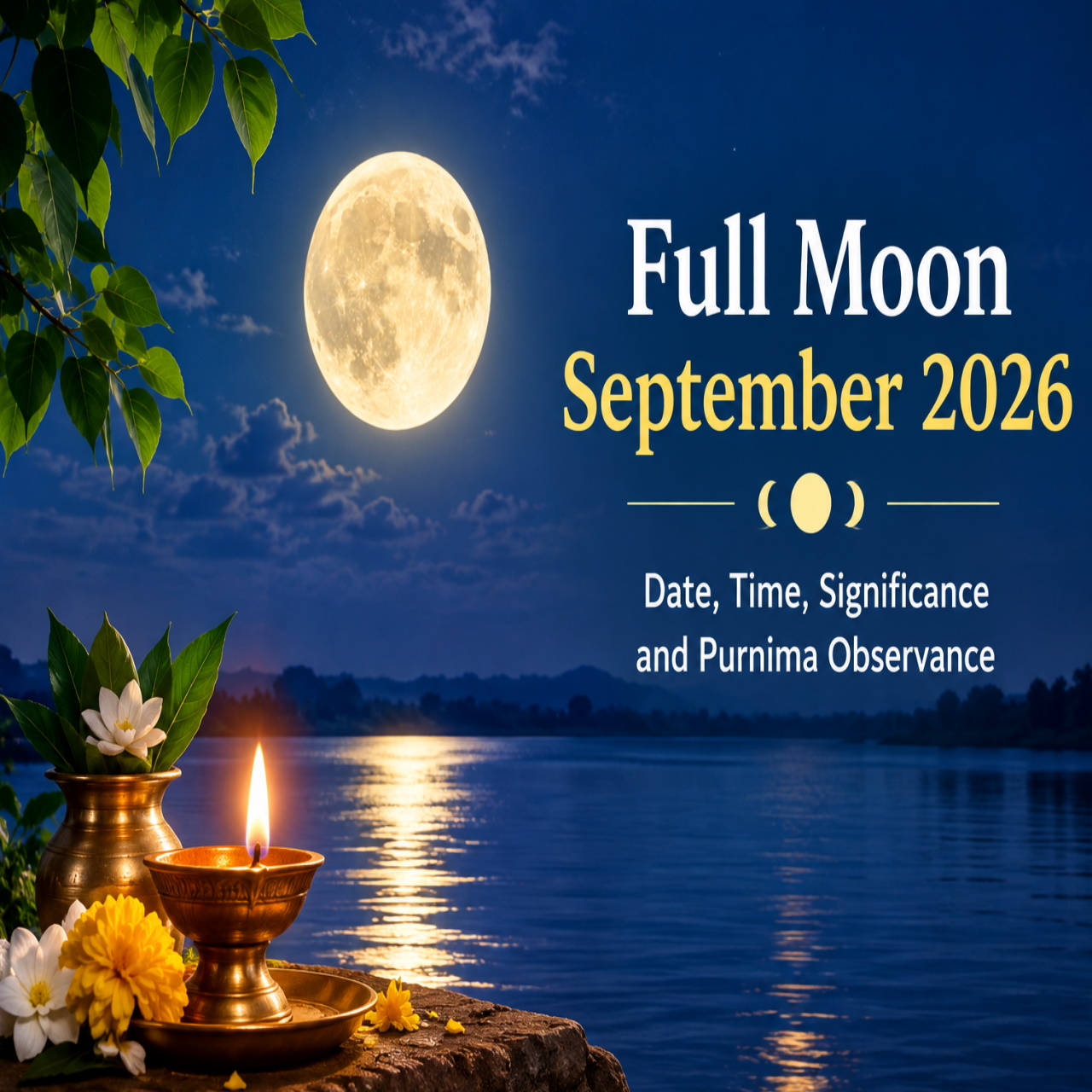
Full Moon September 2026: Date, Time, Significance and Purnima Observance
The Full Moon in September 2026 falls on Saturday, September 26, bringing together astronomical, cultural, and spiritual significance. In India, this Full Moon coincides with Bhadrapada Purnima and Purnima Shraddha, while astronomically it is known as the Harvest Moon.
The September Full Moon is also significant because it comes immediately before Pitru Paksha, the traditional period dedicated to remembering and honoring ancestors. Whether viewed through astronomy, Hindu traditions, family customs, or simple appreciation of the night sky, this Full Moon offers an opportunity for observation, reflection, and gratitude.
September Full Moon 2026 Date and Time
The September 2026 Full Moon occurs on Saturday, September 26, 2026.
For Pune, Maharashtra, the astronomical Full Moon occurs at approximately 10:19 PM IST on September 26.
In the Hindu lunar calendar, September 26 is observed as Bhadrapada Purnima. Panchang calculations for Maharashtra place the Purnima Tithi from late September 25 through September 26.
September 2026 Full Moon at a Glance
Date: Saturday, September 26, 2026
Astronomical Full Moon: Approximately 10:19 PM IST in Pune
Hindu observance: Bhadrapada Purnima
Traditional name: Harvest Moon
Purnima observance: Purnima Shraddha
Following observance: Pitru Paksha begins on September 27
Exact religious timings can vary by location and Panchang calculation, so people performing time-sensitive rituals should check the local Panchang for their city.
What Is a Full Moon?
A Full Moon occurs when the Moon appears fully illuminated from Earth.
The Moon does not produce its own light. Sunlight illuminates its surface, and during the Full Moon phase, the side facing Earth is almost completely illuminated.
The Full Moon occurs approximately once during each lunar cycle. It is one of the easiest lunar phases to observe because the Moon appears bright and nearly circular in the night sky.
What Is the September 2026 Full Moon Called?
The September 2026 Full Moon is called the Harvest Moon.
The Harvest Moon is traditionally defined as the Full Moon closest to the September equinox in the Northern Hemisphere. The name has historical connections with agriculture because the bright Moon around this period traditionally provided additional evening light during the harvest season.
Today, the Harvest Moon is mainly an astronomical and cultural term, but it continues to connect the September Full Moon with ideas of harvest, completion, gratitude, and preparation for a new season.
Bhadrapada Purnima 2026
In the Hindu calendar, the September 2026 Full Moon is Bhadrapada Purnima.
Purnima refers to the Full Moon day in the Hindu lunar calendar. Depending on regional and family traditions, devotees may observe the day through prayer, fasting, meditation, temple visits, charity, Satyanarayan Puja, or other religious practices.
There is no single observance followed by every Hindu family. Customs can differ according to region, community, family tradition, and local Panchang.
Full Moon and Purnima Tithi
Astronomical Full Moon and Purnima Tithi are related but are not exactly the same concept.
Astronomically, Full Moon describes a particular phase of the Moon.
Purnima is a lunar tithi used in the Hindu calendar.
Because these systems use different calculations, the exact astronomical Full Moon time and Purnima Tithi timings can differ.
For September 2026, the astronomical Full Moon occurs on September 26, while the corresponding Purnima Tithi also falls on September 26 according to Indian Panchang calculations.
Bhadrapada Purnima and Pitru Paksha
One of the most important features of the September 2026 Purnima is its connection with Pitru Paksha.
September 26 is observed as Purnima Shraddha in relevant Hindu calendar traditions. The following day, September 27, marks the beginning of the main Pitru Paksha period with Pratipada Shraddha.
Pitru Paksha is traditionally associated with remembering and honoring ancestors. Families who follow these traditions may perform Shraddha, Tarpan, prayers, food offerings, charity, and other customary practices.
Because Shraddha traditions can vary considerably, families should follow their established customs and consult a local Panchang or knowledgeable priest when exact ritual timings are required.
Purnima Vrat
Some devotees observe a Purnima Vrat on the Full Moon day.
Depending on family and regional tradition, this may involve fasting, eating simple vegetarian food, prayer, meditation, or visiting a temple.
Fasting is a personal religious practice and should be approached according to individual circumstances. People who have specific dietary or medical requirements should follow appropriate professional advice.
Satyanarayan Puja on Purnima
Satyanarayan Puja is traditionally performed by many Hindu families on Purnima and other auspicious occasions.
A typical observance may include preparing a clean worship area, offering prayers and food, listening to the Satyanarayan Katha, and distributing prasad among family members and guests.
The exact procedure differs between families and regions.
Charity and Giving
Charity is another practice associated with many Purnima observances.
People may donate food, clothing, educational materials, essential supplies, or money to people in need or charitable organizations.
The September Full Moon can therefore be used not only for personal reflection but also as an opportunity to practice generosity and community service.
How to Observe the September 2026 Full Moon
People can observe the Full Moon according to their personal beliefs and family traditions.
A simple observance could include:
Watching the Moon
Spending quiet time outdoors
Meditating or praying
Practicing gratitude
Reading spiritual literature
Preparing traditional food
Visiting a temple
Spending time with family
Practicing charity
Those following Purnima or Shraddha rituals should use their local Panchang for specific timings.
Full Moon, Reflection and Gratitude
The Full Moon has been associated with reflection in many cultural traditions.
The Harvest Moon provides a natural theme for looking back at the previous months and recognizing progress.
You might reflect on:
Goals you have completed
Lessons you have learned
Relationships you value
Habits you want to improve
Projects that require attention
Plans for the coming season
The idea of harvest can also represent the results of patience and effort. It provides a simple reminder to appreciate progress instead of always focusing on the next goal.
Enjoying the Full Moon Outdoors
The September Full Moon can be enjoyed without special equipment.
On a clear evening, find a location with a relatively unobstructed view of the sky and observe the Moon as it rises and moves across the night.
You can also look for:
Bright stars
Cloud formations
Nearby landmarks
The changing position of the Moon
The contrast between natural moonlight and city lighting
For children, the Full Moon can provide a simple introduction to astronomy and the different phases of the Moon.
Full Moon Photography Tips
The September Full Moon can also be an excellent photography subject.
For clearer Moon photographs:
Use a tripod or stable surface
Keep ISO relatively low
Use manual focus when possible
Avoid excessive digital zoom
Take several photographs using different exposures
Include buildings, trees, or landscapes for scale
A landscape photograph with the Moon can often create a stronger visual story than a close-up photograph of the lunar surface.
Sustainable Full Moon Celebration
A meaningful celebration does not require excessive decoration or waste.
A more sustainable observance can include:
Using reusable lamps and decorations
Avoiding unnecessary plastic
Preparing food in suitable quantities
Keeping outdoor areas clean
Donating useful items instead of buying unnecessary gifts
Reducing noise and respecting local surroundings
Simple celebrations can preserve cultural traditions while reducing environmental impact.
Astronomy and Indian Lunar Traditions
India has a long history of observing lunar cycles and using them in traditional calendars.
Hindu calendars use lunar and solar calculations to determine dates for festivals, religious observances, and other important occasions.
Modern astronomy and traditional calendars use different systems, but both encourage people to observe the Moon and understand its changing cycle.
The September 2026 Full Moon is a good example of how one lunar event can have both scientific and cultural importance.
September Full Moon 2026: Science and Tradition Together
The September 2026 Full Moon connects several areas of interest.
From an astronomical perspective, it is the Full Moon closest to the September equinox and is therefore called the Harvest Moon.
From a Hindu calendar perspective, it is Bhadrapada Purnima and is associated with Purnima Shraddha.
The following day marks the beginning of Pitru Paksha in the cited Hindu calendar tradition.
This combination makes the September Full Moon particularly meaningful for people interested in astronomy, Indian culture, spirituality, family traditions, and seasonal observances.
Conclusion
The Full Moon of September 2026 falls on Saturday, September 26.
It is the Harvest Moon in the Northern Hemisphere and corresponds with Bhadrapada Purnima in the Hindu lunar calendar. For many devotees, the day may include prayer, fasting, charity, Satyanarayan Puja, meditation, or family traditions.
The date is also important because Purnima Shraddha is followed by the beginning of Pitru Paksha on September 27.
Whether you observe the Moon from an astronomical perspective, follow Purnima traditions, spend time with family, practice gratitude, or simply enjoy the night sky, the September 2026 Full Moon provides a meaningful opportunity to pause and appreciate the connection between nature, culture, and tradition.
The September 2026 Full Moon is Bhadrapada Purnima
Learn about the September 2026 Full Moon, Harvest Moon, Bhadrapada Purnima, date and time in India, Purnima traditions, and its connection with Pitru Paksha.
◉ 45 views◇ 0 comments

0 comments
Be the first to add a thoughtful comment.
Leave a comment
Your email will not be published. Comments are moderated.